
How to Analyze Your Fishing Forecast on Fish Licker AI
Plan smarter. Search your lake forecast now.
Fish Licker combines solunar tables, barometric trends, water clarity, and species behavior to predict your bite.
How to Analyze Your Fishing Forecast on Fish Licker AI
A Fish Licker forecast takes about ninety seconds to generate. Reading it well takes a little longer, and that is where most of the value is.
A Fish Licker forecast takes about ninety seconds to generate. Reading it well takes a little longer, and that is where most of the value is.
The results page holds a written AI analysis, four condition cards, solunar windows, a lure plan broken out by time of day, moon dials, a ten-day trend read, and four hourly weather charts. If you only scroll for "best time to fish," you miss most of it.
This guide goes through every panel in the order you will see them. The example forecast is a summer largemouth bass day in La Crosse, Wisconsin.
The AI Analysis Report
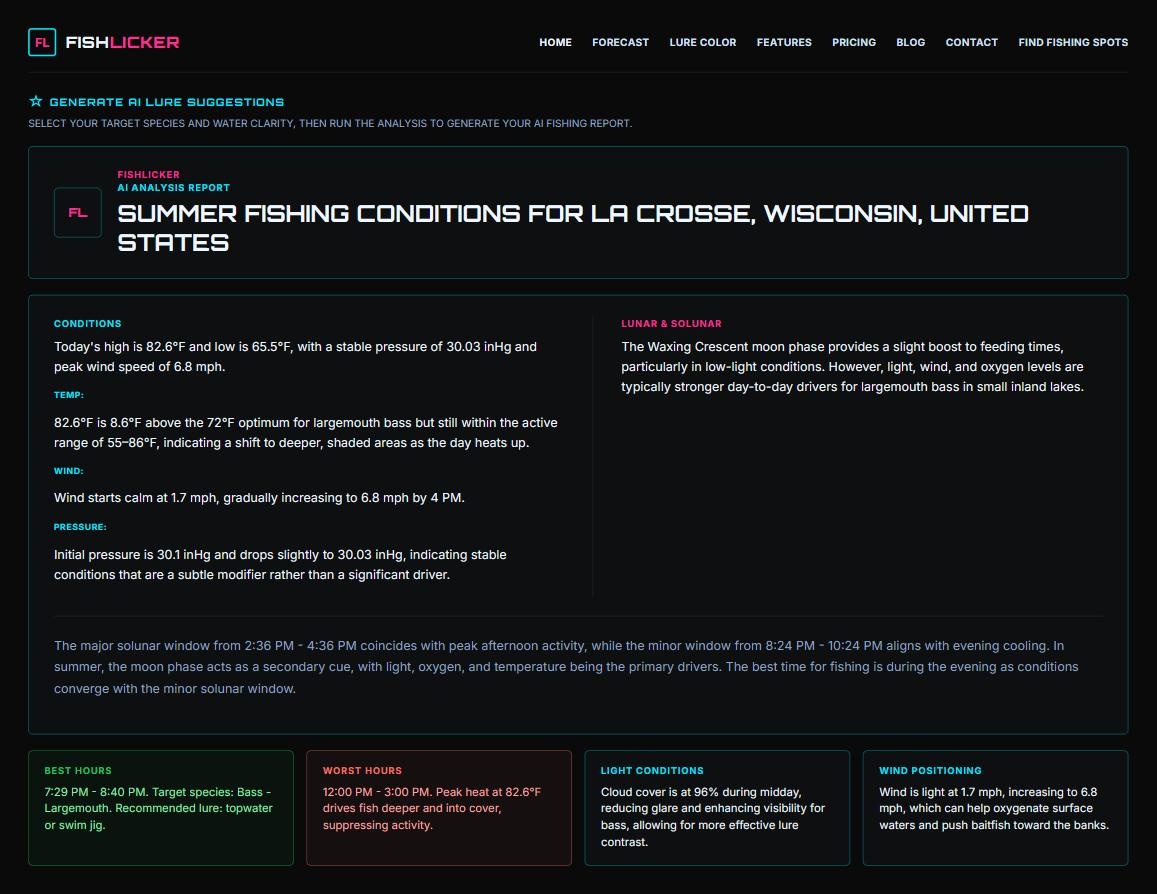
The page opens with a headline for your location and season, here Summer Fishing Conditions for La Crosse, Wisconsin, followed by a written breakdown. The numbers are still there further down the page. This section explains what they mean for the fish you picked.
Reading the Conditions panel
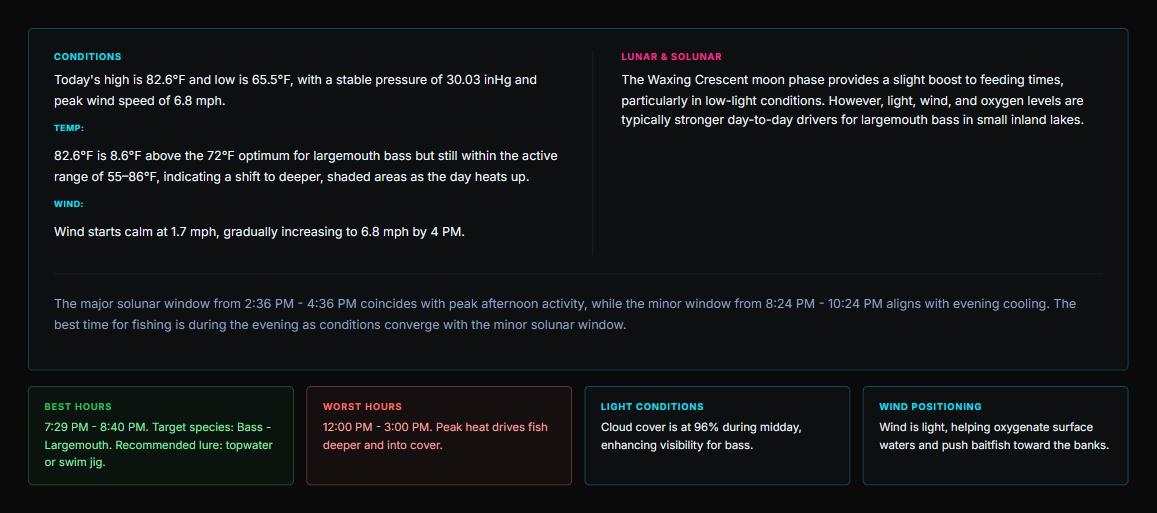
The left column stacks four short reads. Each pairs a measurement with what it means for the fish:
- Summary: high of 82.6°F, low of 65.5°F, stable pressure at 30.03 inHg, peak wind 6.8 mph
- Temp: 82.6°F is 8.6° above the 72°F optimum for largemouth but inside the 55 to 86°F active range, so expect fish to slide deeper and into shade as the day heats up
- Wind: calm at 1.7 mph, building to 6.8 mph by 4 PM
- Pressure: starts at 30.1 inHg and eases to 30.03, a small change that modifies the bite more than it drives it
Pay attention to that last point. The app separates drivers, the factors doing most of the work on fish behavior, from modifiers, which matter less. When pressure is labeled a modifier, don't build your day around it.
The Lunar & Solunar column on the right works the same way. It notes that the waxing crescent gives feeding a slight boost, then says light, wind, and oxygen are usually stronger day-to-day drivers for largemouth in small inland lakes.
Best hours, worst hours, light, and wind
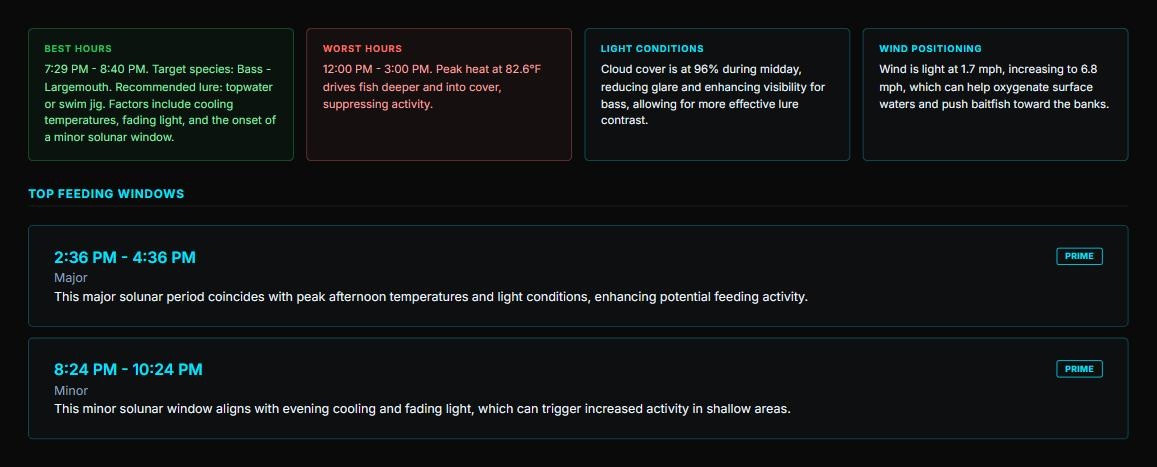
Four cards summarize the day:
- Best Hours: 7:29 to 8:40 PM, largemouth on topwater or a swim jig, driven by cooling temperatures, fading light, and the start of a minor solunar window
- Worst Hours: 12:00 to 3:00 PM, when peak heat pushes fish deeper into cover
- Light Conditions: 96% cloud cover at midday cuts glare and makes lure contrast easier for bass to see
- Wind Positioning: light wind building to 6.8 mph, enough to oxygenate surface water and push baitfish toward the banks
Under these cards, Top Feeding Windows lists the solunar periods with a Prime tag and a short reason. In this example, a 2:36 to 4:36 PM major lines up with peak afternoon temperature and light, and an 8:24 to 10:24 PM minor lines up with evening cooling.
Efficiency by Period

This color-coded strip rates Morning, Midday, Afternoon, Evening, and Dusk. The example day reads Morning Good, Midday Average, Afternoon Average, Evening Good, and Dusk Excellent.
If you only have three hours to fish, this strip tells you which three. Each block expands with its reasoning. Morning rated Good because temperatures near 75°F, low light, and steady pressure all favor active feeding.
The Tactical Time Windows
Below the summary, a tabbed section rebuilds your lure selection for each part of the day. Each window ranks its lure picks, and every lure card lists weight, color, the reason for that color, the technique, and where to fish it.
Morning
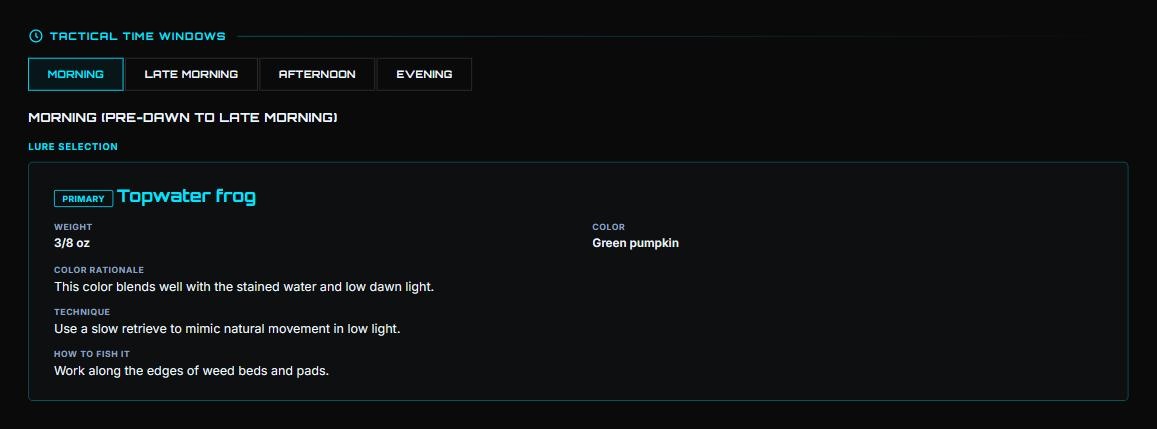
The top morning pick is a topwater frog, 3/8 oz, in green pumpkin. The color blends with stained water and low dawn light. Work it slowly along the edges of weed beds and pads.
The backup is a swim jig, 1/4 oz, in white/chartreuse, chosen for visibility in stained water and retrieved steadily through emerging weed edges.
Read the color reason on every card. Over a few trips it teaches you the rules behind the picks, so you can make the call yourself when you are standing in front of your tackle box.
Late morning
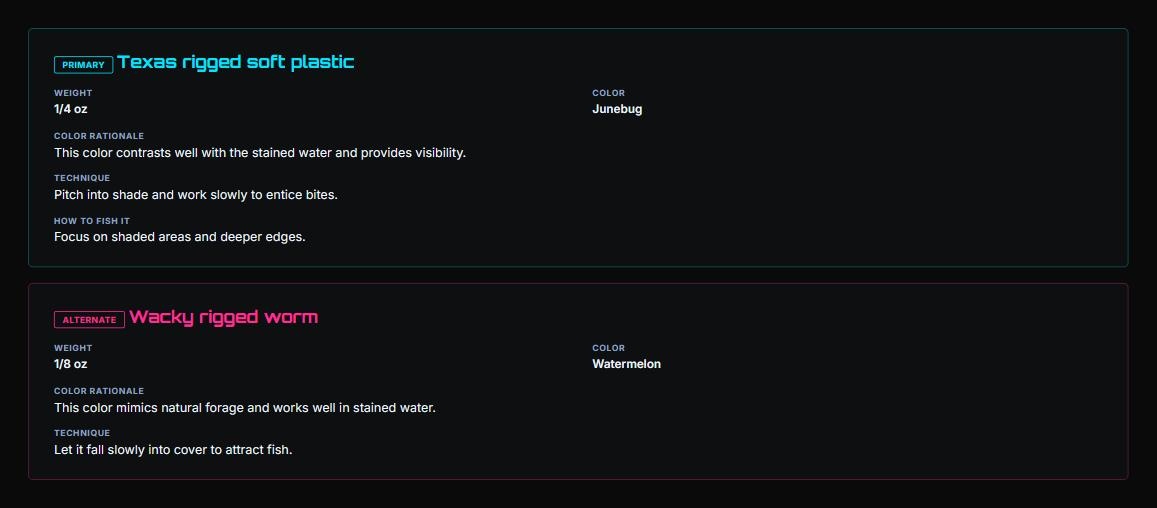
Switch to the Late Morning tab and the cards change. The top pick becomes a Texas rigged soft plastic, 1/4 oz, in junebug, which shows up well in stained water. Pitch it into shade and work it slowly along deeper edges. The backup is a wacky rigged worm, 1/8 oz, in watermelon, left to fall slowly into cover.
The plan is already following the fish off the surface and toward shade.
Afternoon
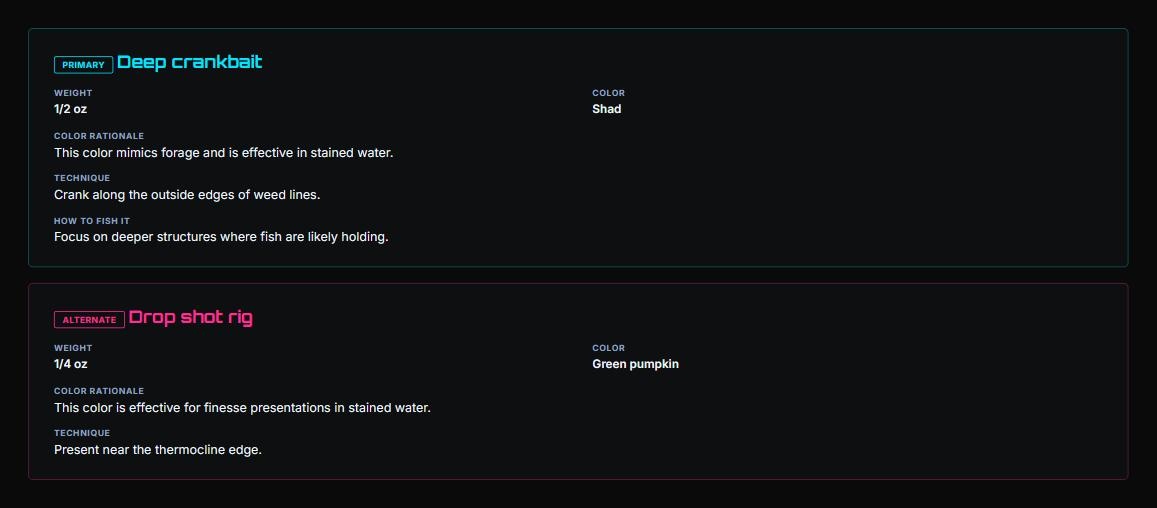
The top afternoon pick is a deep crankbait, 1/2 oz, in shad, which matches forage and stays visible in stained water. Crank it along the outside edges of weed lines where fish hold in the heat. The backup is a drop shot rig, 1/4 oz, in green pumpkin, fished near the thermocline.
This lines up with the Worst Hours card. Midday heat pushed the fish deep, so the afternoon plan goes deep with them.
Evening
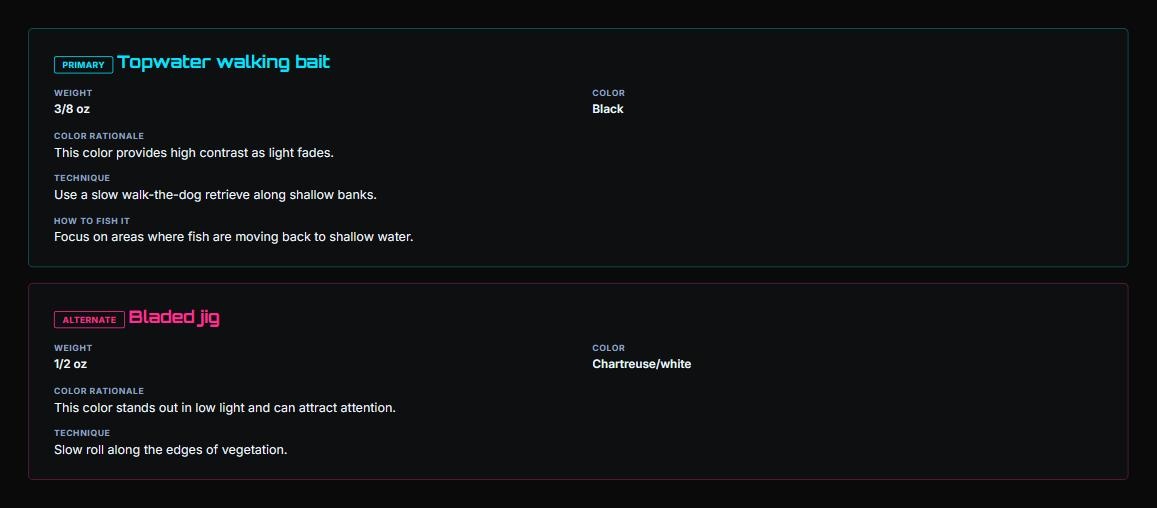
The evening window carries an exact time: 7:29 to 8:40 PM, ending at civil twilight.
The top pick is a topwater walking bait, 3/8 oz, in black, worked with a slow walk-the-dog retrieve over shallow flats where fish are moving back up. The backup is a bladed jig, 1/2 oz, in chartreuse/white, slow-rolled along vegetation edges.
Black works here because a dark bait makes a sharp silhouette against a bright evening sky, which is what a bass looking up needs to track it.
The environmental data
Past the tactical plan, the page shows the raw data the AI worked from, so you can check its reasoning.
Current conditions and thermal trend
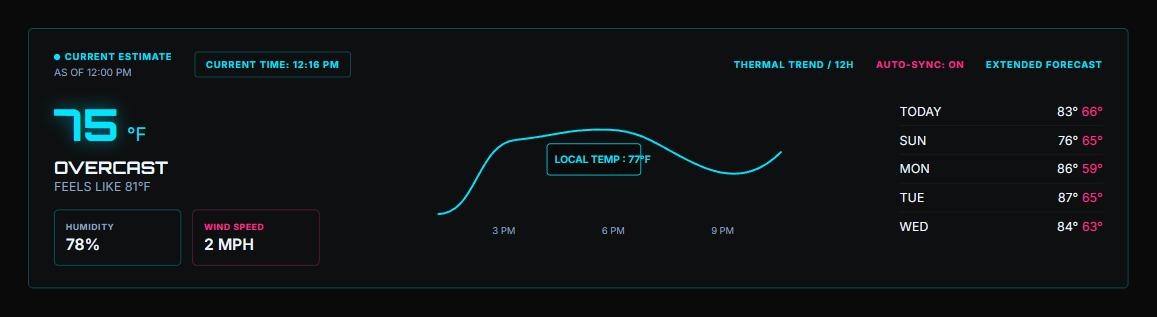
This card shows the current estimate, feels-like temperature, humidity, wind speed, a 12-hour temperature trend, and a five-day forecast with highs and lows. Auto-Sync: On means the data refreshes on your forecast location's clock rather than your device's.
Rain and the next six hours
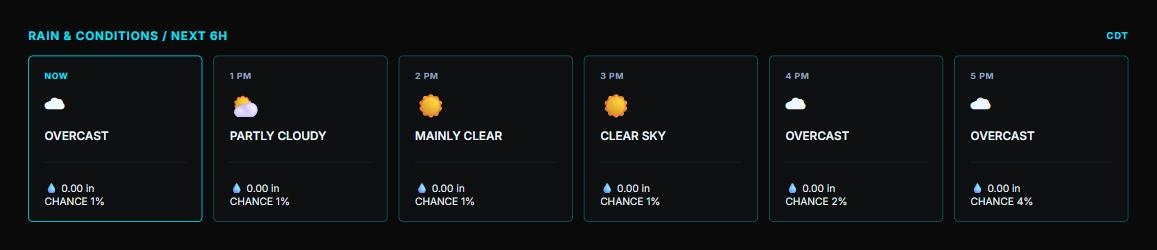
Hour-by-hour blocks show sky condition, rainfall, and chance of rain. Check it before you commit to a window that might get washed out.
Astronomical Recon

Twilight start (5:37 AM), twilight end (8:40 PM), solar transit, and moon phase. Write down twilight end. It sets the hard stop on the evening topwater window, and it is the time the tactical panel used for that window.
The Solunar Cycle
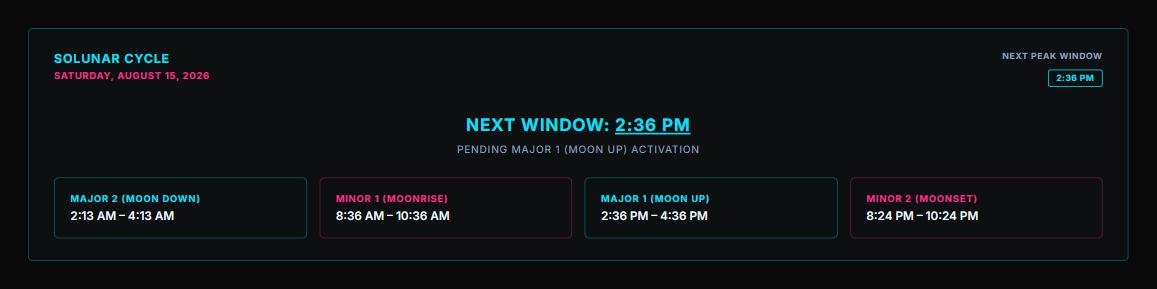
All four solunar periods, with a countdown to the next peak. In the example: Major 2 (moon down) 2:13 to 4:13 AM, Minor 1 (moonrise) 8:36 to 10:36 AM, Major 1 (moon up) 2:36 to 4:36 PM, and Minor 2 (moonset) 8:24 to 10:24 PM.
The Angler's Watch
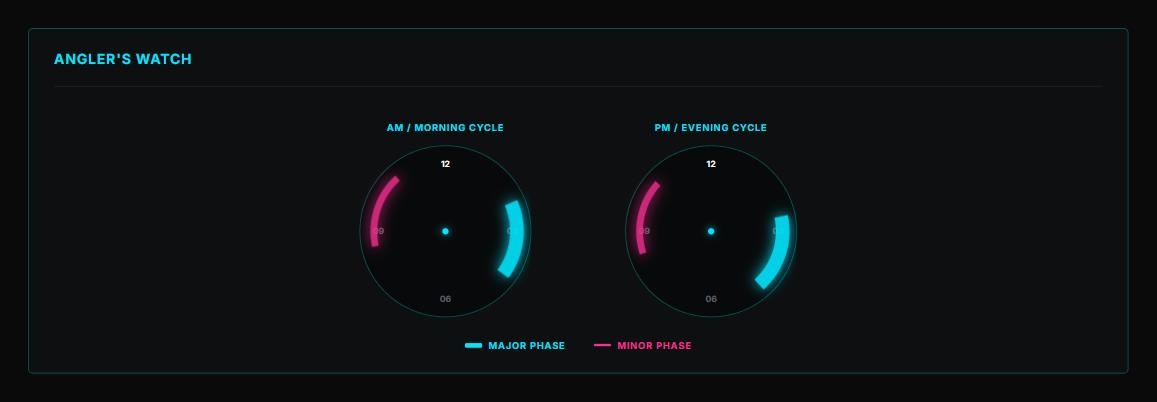
Two dials, one for the morning cycle and one for the evening, show major periods in cyan and minor periods in magenta on a 12-hour face. On the boat, a dial is quicker to read than a table of times.
Trend Intelligence
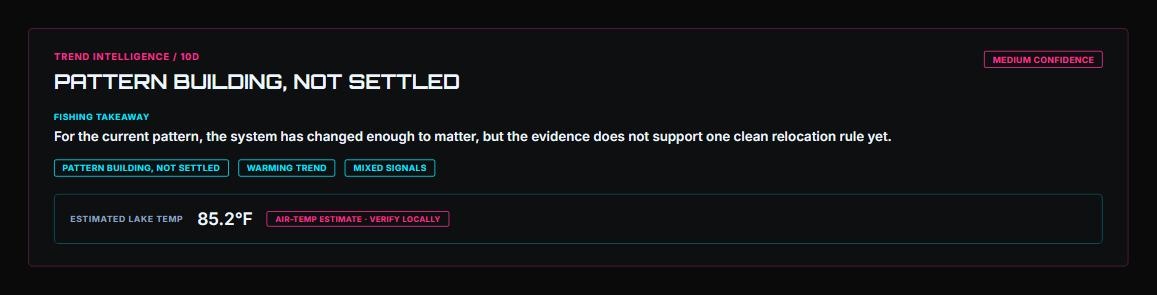
This panel looks back ten days and classifies the weather pattern. The example returned Pattern Building, Not Settled at Medium Confidence, tagged Pattern Building, Warming Trend, and Mixed Signals. The estimated lake temperature of 85.2°F is flagged as an air-temperature estimate you should check locally.
The takeaway says conditions have changed enough to matter, but the evidence doesn't support one clear rule for where the fish moved. When you see Medium confidence and Mixed Signals, hedge your day across more than one pattern.
The hourly charts
Four interactive charts cover the past 6 hours and the next 18. Hover any point for exact values. Each chart has a Now line.
Wind
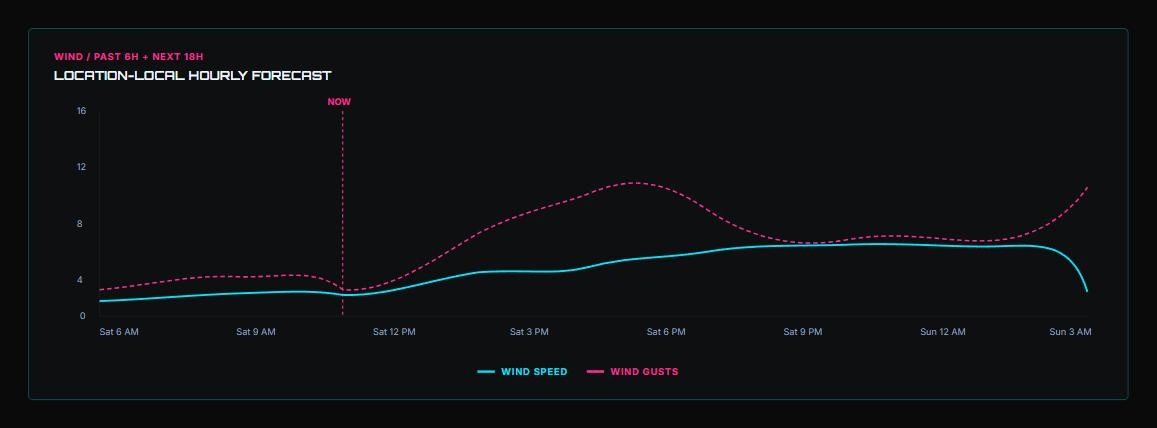
Wind speed and gusts by the hour. Hovering a point shows, for example, 5.5 mph with gusts to 12 mph. Use it to find the hour a windblown bank starts to turn on.
Cloud cover
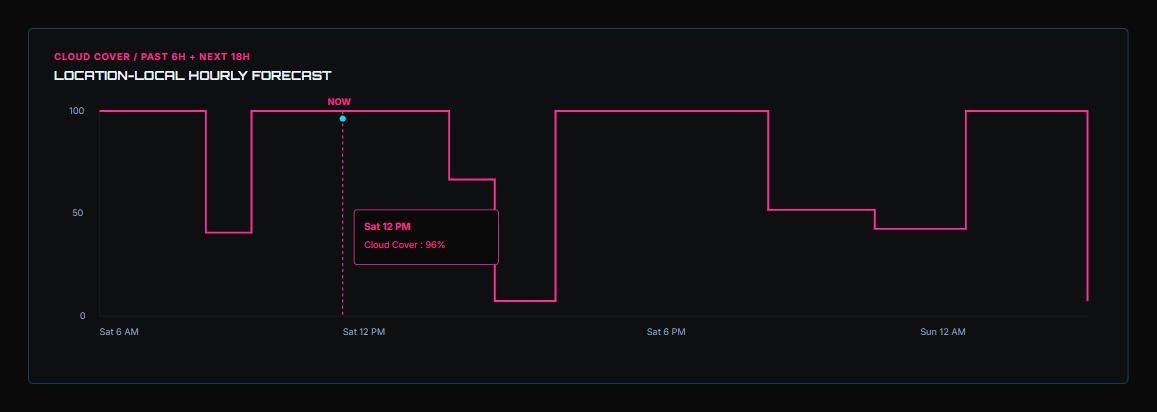
Cloud cover percentage over the same span, with steps where the sky clears and closes back up. Light was a primary driver on this example day, so this chart deserves more attention than the wind chart.
Pressure
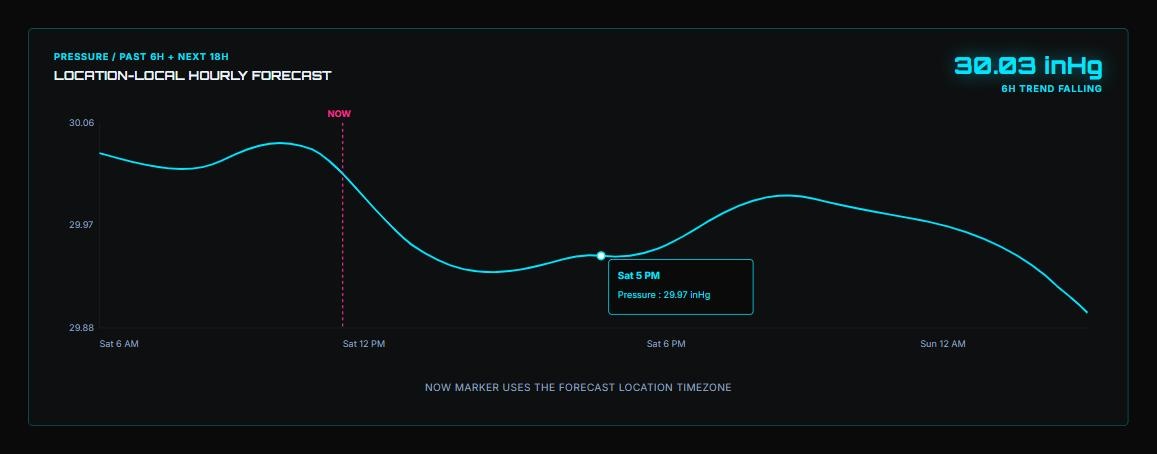
Barometric pressure with the current reading and a trend flag, here 30.03 inHg and 6H Trend Falling. Falling pressure ahead of a front often triggers feeding, and this chart shows when the drop starts. The Now marker uses the forecast location's time zone.
Daily Telemetry Log
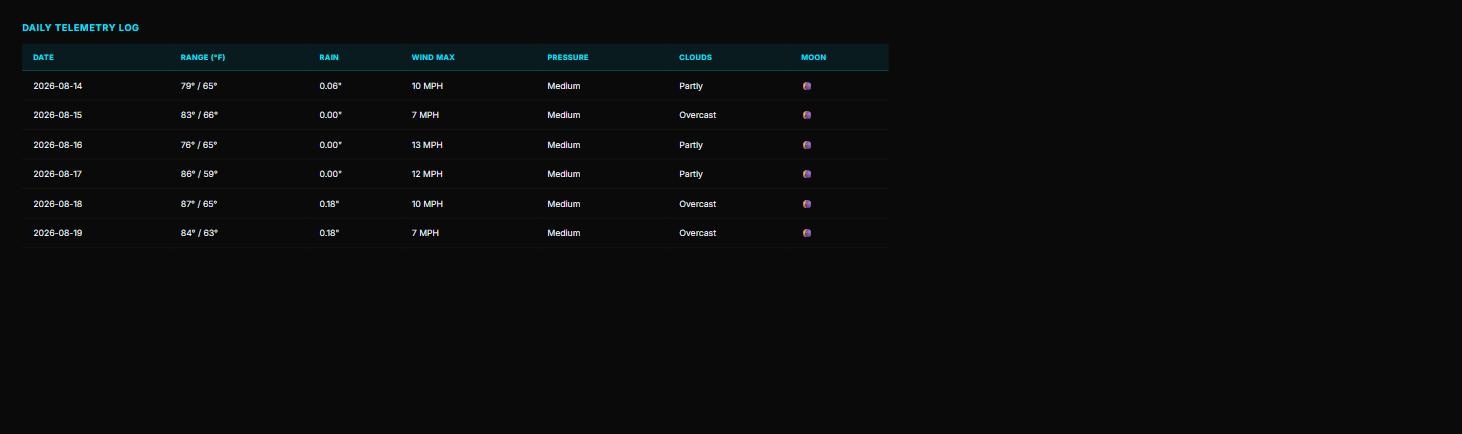
A seven-day table of temperature range, rain, max wind, pressure, cloud cover, and moon phase. This is the data Trend Intelligence reads. If you keep a fishing log, these conditions are worth saving next to each catch.
How to use the page on a real trip
Read it in three passes:
Read it in three passes:
- Efficiency by Period to decide when to go
- Tactical Time Windows for that period to decide what to tie on
- Trend Intelligence to decide how hard to commit to the plan
The rest of the page is there to check the AI's work. If what you see on the water disagrees with it, trust the water.
Want a second opinion? The two buttons under the report export the full set of conditions. Ask Perplexity opens a chat with everything loaded, and Copy Conditions copies the same data as plain text to paste into ChatGPT, Gemini, or Grok.
Fish Licker AI is free during the public beta: local weather, solunar timing, AI fishing analysis, and lure color guidance.
Frequently Asked Questions
What's the difference between drivers and modifiers on the Conditions panel? Drivers are the factors doing most of the work on fish behavior that day, such as heat, light, and oxygen for largemouth in the example. Modifiers, like a small pressure change or a slight moon boost, matter less and shouldn't decide your whole plan.
Why does the evening lure pick use a black bait as it gets dark? A dark bait makes a sharp silhouette against a brighter evening sky, which is easier for a bass looking upward to track than a lighter or natural color.
How much should I trust the Trend Intelligence confidence rating? Treat Medium confidence with Mixed Signals as a reason to hedge across patterns. High confidence with a single clear trend is safer to commit to.
Plan smarter. Search your lake forecast now.
Fish Licker combines solunar tables, barometric trends, water clarity, and species behavior to predict your bite.
Fish Licker Team
Automated Fishing ForecastFish Licker was developed to automate complex fishing analysis by combining deterministic weather modeling, USNO sun/moon transits, solunar calculation theory, and species behavior rules. Our goal is to synthesize environmental variables into an actionable pre-trip checklist to help anglers make more informed decisions on the water.